Thursday, December 31, 2009

Makgadikgadi Pans National Park, Kubu Island 1 – 5 November


We stayed at the Khumaga Campsite for the first two nights. There was a river close by that we did most of our game viewing at. We saw a variety of animals including hippos, giraffes, elephants and zebras. We had our own camp elephant (we called him Cedric) that came to visit both nights. On the first night he kept its distance and was hanging around eating behind the toilet block. But on the second night Cedric ate his way around our campsite while I was cooking tea and we got to watch him munching on trees, less that 15m away from us, while we ate.


Just another normal day at school


Dinner time Cedric viewing

Kubu Island


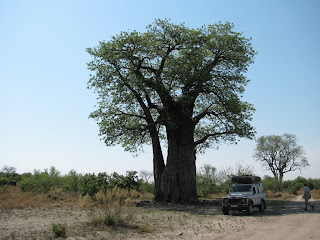
The next morning we had a 7 hour trip onto the salt pans to stay at Kubu Island. It isn’t surrounded by water this time of year, it's just a higher group of rocks in the middle of nowhere dotted with baobab trees. We camped in the shade of an enormous baobab tree that was eight meters wide. I climbed the tree with Zane and it has to be said I was a tad worried I wasn’t going to be able to get down. Tana came to the rescue and gave me a hand. I don’t think I’ll be playing that game in the near future (well not until I feel the need to prove I’m not that old again). On our first night we walked to the highest point of the island to watch the full moon come up over the salt pans. It was pretty amazing. Because there is no wild game around Kubu Island we could walk around and explore the island. It was nice to get out and about since we’ve had to stay in the car in most places. This also meant that there would not be any elephant or rhino noises to wake us up (not that I’m complaining, it’s a pretty cool thing to be woken by). We did however have a herd of cows that promptly surrounded us once we were in the tents. They are the loudest peeing noises I’ve ever heard: so much for our quiet night. The second night Tana thought she had it sorted and got up and scared the cows off. As soon as she got back in the tent the rain, gales and thunder started and of course that was joined by my hysterical laughter.


Before I got stuck


Being at one with the pan


Monday, November 16, 2009

Moremi Game Reserve 26-29 October


Hippo print


Moremi is the north eastern part of the Okavango Delta. We drove past the most beautiful scenery on the way in. Beside the river there was lush, green grass, trees and reed covered marshes. To make it that bit more scenic there were also hundreds of elephants clustered around and in the water. We also got to see our first Red Lechwe (antelope) which there are thousands of in the park


Bob (the GPS) had a bit of trouble navigating us to our campsite as there were creeks running across some of the roads we were supposed to take. Of course Bob didn’t realize there was water so sounded like a broken record repeating “do a u-turn when possible”, whenever we turned away from the river. Luckily for us we came across some local guys, who were driving the gear for a safari group, doing a u-turn at one of the creeks. They led us to another road, also with a creek running across it, and walked/swam in front to show us the shallowest part. The reason we hadn’t tried that ourselves was because of croc’s. They obviously weren’t too worried because they went for another swim after we had crossed. After that Tana became our official road/creek crosser. We did make it to our camp without drowning the landie.
That night we were woken several times by very strange noises not too far from the tents. Most of the noises we weren’t able to identify but one sounded like a pack of wild dogs rounding up and killing something. From the noises that were made it wasn’t a quick death.

Our next stop was Xakanaxa Campsite for three nights. We did school inbetween drives to find animals. There wasn’t much to see the first day but during the next two days we saw heaps of animals feeding near the road. There were mostly impala, red lechwe and elephants. A few times we were sitting in the Land Rover with a herd of elephants chomping or drinking close by and crossing in front of us.


On our 2nd and 3rd night at Xakanaxa we went on a two hour boat ride. We saw hippos both times and parked in the reeds close by so we could sit on the roof and watch them. When we came to hippos the driver would shift into reverse and rev loudly and when they went under water he zoomed past them. He said that if we went slowly past them they would see us as a threat and attack. We also pulled into the nesting area of Yellow Billed Stork, Marabu Stork and Cattle Egret - impressed with my bird knowledge? I got Zane to tell me what they were. There were eggs, fluffy chicks and parents coming and going. A sneaky crocodile was lying in wait under the bushes ready for any chicks that fell out of their nests. The sunset on the way back was stunning.


Our next stop was 3rd Bridge Campsite. While tiki touring and checking out the local area we came across a place that did mokoro rides (like a dug-out canoe) so we went on a one hour paddle – OK so we didn’t paddle, the boat guy stood in the back and poled us down the river while we sat back and took in the scenery. The people in front of us came back early because there were three hippos in the way. It was very peaceful and a totally different experience to the motorboat but it wasn’t very stable and I’m not sure I could do days like some people do.


Saturday, October 31, 2009

Chobe National Park 21 – 25 October


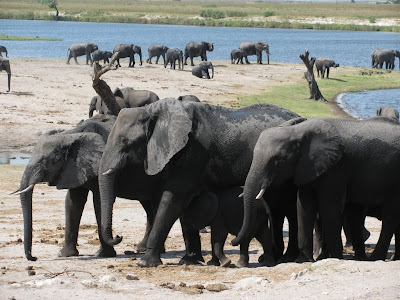
Chobe, like Kaudum, is not fenced but you are only allowed out of your vehicle at designated areas. On the way to our first campsite, Ihaha, we saw herds of impala, lone elephants as well as parades of them, a Spotted Hyena resting in the grass, a pair of massive kudu bulls looking down at us from the top of a rock face, hippo’s wallowing in the water, crocodiles sunbathing on the banks of the river, warthogs snuffling the ground and more and more elephants. There were elephants everywhere. We couldn’t drive down one road because it was blocked by them and they weren’t moving.


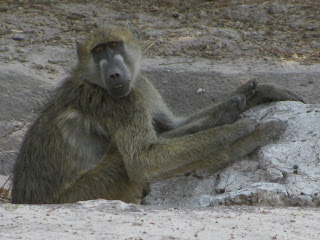
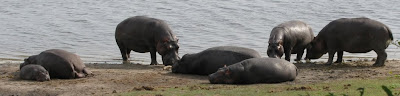
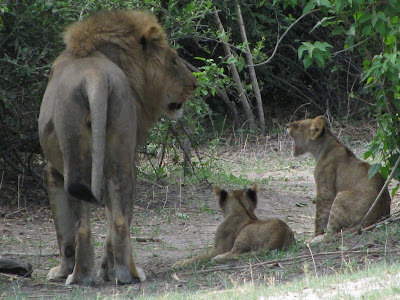
Both mornings at Ihaha we woke up to buffalo grazing just downstream from our campsite. On our second day we saw a bloat of hippos snoozing on the beach just down from the road. We also saw a lion, two lionesses and two cubs lounging by the road, a troop of well over 100 baboons with lots of cute little babies (even smaller than Marlin from N/a an ku se) and a parade of 70+ elephants that got as close as 2m from us (we were in the Land Rover of course). At one point we had three of the large bulls coming straight at us. That was very freaky. That night, while eating dinner, we got to watch a hippo make its way back up stream.


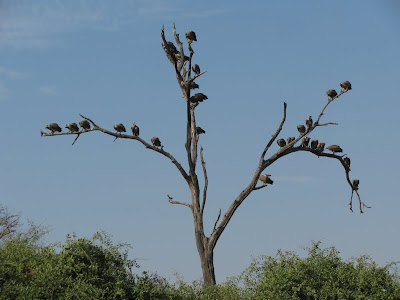
We spent the next two nights at Savute (Sa-vu-te). While driving there we saw a baby leopard (our first in daylight) sitting beside the road. Its mum must have been further back in the bush with a kill as there were vultures everywhere waiting for the leftovers.


Down at Savute there were heaps of enormous bull elephants. They were a motley bunch. One had ripped ears, another had a missing tusk, and others had broken or worn down tusks. The bathrooms at the campsite had elephant proof walls built around the outside of them and the water taps at the campsites were in a concrete block. You had to put your hand trough some PVC pipe in the side to get to the tap. There were also squirrels, mongeese and birds poking around our site looking for food. I was freaked out the first night by the noise of something trying to get at our rubbish. It ended up being a honey badger.

The next day we went for a drive to see some 3000 year old Bushman art and after that we stopped at a baobab tree to stretch our legs and collect some fire wood. While we were there a pack of eight wild dogs ran past only a few meters away.

Kaudum National Park 14-16 October


We spent two nights in Kaudum. It is not fenced like Etosha so the animals can come and go as they like, including into the campsite, and you are allowed out of your car. Unfortunately it had rained in the last couple of days so the animals can get water from places other than the waterholes near the roads with hides.

Mornings were spent doing school work and hanging out then in the afternoons we would drive to a waterhole and wait for the animals to come. On our first afternoon we saw a herd of 30+ elephants. I was standing at the Land Rover getting snacks, of course, when then came running over the hill towards the waterhole. They would have been no further than 15m from me. Just after they arrived 6 roan antelope were hanging back waiting for their turn at the waterhole and later on a hyena was lurking about.

During the second afternoon at a different waterhole I saw a lone wildebeest, some warthogs (they’re just like Pumba in the Lion King, except for the talking bit), a parade (Is it obvious we’ve been learning the collective nouns for animals? My favourites are a bloat of hippopotami and a crash of rhinoceroses) of 20+ elephants and another hyena lurking (because that’s what they do) around.

That night I heard hyena howling, a couple elephants that sounded like they were eating next to the tents, and growling from an unidentified animal that was a tad close for my comfort.